Showing posts with label autosomal DNA topics. Show all posts

Wednesday, 10 July 2019

Optimising your Anonymity & Privacy with DNA tests

Here are some practical hints and tips to optimise your Privacy if you are thinking of doing a DNA test (or you have already done one).

1) Don’t test!
This is the simplest way to avoid exposing your self to potential online scrutiny and unwanted intrusion from others. If you are not sure whether you should do a DNA test or not, do yourself a favour and don't test. You will only worry about it if you do.

2) Get your brother to do it instead
Some people are less concerned about privacy than others ... so if this is how one of your siblings feels, why not ask them to test instead? One person I know did this and everyone was happy. Win-win.

3) Don't use your Real Name
You are not obliged to use your real name. You can use whatever name you want. I don't recommend using "Clint Eastwood" (unless you want unlimited fan-mail) - much better to use something completely nondescript like John Williams or Jane Jones.

Genealogically it makes sense to use your surname (as this will help with any genealogical research) but again, it's not essential. You can just as easily use an alias, a pseudonym, or a nom de plume. Or even a sequence of letters & numbers … FYL227 has a particular ring to it.

A cunning disguise will fool most people
(this is obviously Groucho Marx in a wig)

4) Disguise your Personal Information

Similar to above, you are under no obligation to use your real date of birth. Now is the perfect opportunity to take 10 years off your age. I did and I feel so much better.

You could also create a bespoke, untraceable email address just for your DNA tests. It's easy to set one up on Gmail and have any messages directed to your inbox. I believe 1234567@gmail.com is already taken but something similar would work just as well. It would be extremely difficult to identify you from a seemingly random combination of letters and numbers.

Only give the minimum amount of information necessary. I don't bother with my postal address or telephone number. If they can't reach me by email then I am probably on a retreat to the North Pole and they are unlikely to reach me by snail mail or telephone either.

5) Privatise your DNA account
All the testing companies allow you the option to make your results completely private. For some, this means that your matches cannot see you, but you cannot see them either. And this seems like it might defeat the purpose of doing the test in the first place, but not so! You can de-privatise your results when you want to work on them, and re-privatise them when you have finished. This minimises the amount of time you are "exposed to public view" by your matches.

Here is how to privatise your DNA matches on the various websites ...
  • Ancestry: go to Your DNA Results Summary, click on Settings, then scroll down to Visibility & Sharing, click on DNA Matches, tick the Off button, and click Save. To reverse this process, tick the On button, and click Save. Once you have privatised your DNA matches, they cannot see you and you cannot see them.
  • 23andMe: click on your name or icon in the top right, click on Settings, scroll down to Privacy / Sharing, click on the Edit button, scroll down to DNA Relatives and click on Manage your Preferences, then click on "I would like to stop participating in DNA Relatives". Then click the Finish button. Once you have privatised your DNA matches, they cannot see you and you cannot see them.
  • MyHeritage: click on your name in the menu bar at the top, then click on My Privacy, then click on My DNA Preferences, then select the DNA kit you wish to customise (from the drop-down menu), then untick the Enable DNA Matching box, and then click on Save Once you have privatised your DNA matches, they cannot see you and you cannot see them.
  • FTDNA: click on your name in the menu bar at the top, then click on Account Settings, then click on Privacy & Sharing, and then under Matching Preferences, click on the button beside Opt in to Matching so that it switches to the Off position. Your changes are automatically saved. A pop-up box appears at the bottom of the page after about 10 seconds stating "Your selections have been saved".  Once you have privatised your DNA matches, they cannot see you and you cannot see them.
  • LivingDNA: click on Profiles in the menu bar at the left, select your profile, scroll down to Family Matching, click on Opted In, tick the Opt Out button, and then click Save Once you have privatised your DNA matches, they cannot see you and you cannot see them.
  • GEDmatch: on the Home Page, scroll down to Your DNA Resources and find your kit number. Click on the Edit icon to the right of your kit number. Scroll down to Public Profile, and under Change Access, tick the Research button and then the green Change button. This makes your kit private and no one can see you as a match, but you can still see all your DNA matches.

6) Privatise your Family Tree
Without a family tree attached to them, DNA results are relatively useless. You could show up as a close "2nd cousin match" to someone else but if you haven't supplied any family tree information, it can be very difficult for them to figure out how you fit in to their tree.

Keeping your family tree private is as effective as keeping your DNA results hidden (if not moreso).

7) Delete your DNA account

If you have finished working with them, you could delete your results completely. This works really well if you have transferred your results to a particular website from another company - you can always keep the original results on the website you initially tested with and re-upload them again at any time.

Similarly, you can delete your kit from any website and have your sample destroyed.

So there are ways and means of finding the level of privacy and security that you personally feel comfortable with. Can you think of any others? Leave a comment below. 

Have fun! Play safe!
Maurice Gleeson
July 2019
updated Sep 2023


Tuesday, 9 July 2019

Irish Mother finds her son ... 60 years later

When it came time for her to deliver, she was taken into a room and put to sleep. When she woke up, the large bump of her pregnancy was gone, and so was her child. For the past 60 years she has always wondered if it was a boy or a girl - they wouldn't tell her.

Now, 60 years later, thanks to DNA, she knows. It's a boy.

There are many people in Ireland searching for their birth family. Some are adoptees, some are foundlings, some are people who were raised in industrial schools, some of whom were boarded out. Over the past few years, many of these people have turned to DNA for help, and these numbers are increasing all the time as the success stories of people finding family through DNA are becoming more widespread.

But it's not just the children that are searching for their families, it's the parents too. I have been working with several birth mothers (in their 70s and 80s) who are trying to locate the child that was taken away from them many decades beforehand. Many tell a similar story, like the one at the top of this article. They had little control over what happened to them. Decisions were made for them. And they were left with little or no information about the child they gave birth to, not even what gender it was.

I am delighted to announce that one of my clients (the woman above) has finally reconnected with her son. She gave up her child 60 odd years ago, and it only took 12 months for DNA to find him. She tested with Ancestry and then uploaded her data to FamilyTreeDNA, MyHeritage & Gedmatch (the recommended approach).

Now comes the next step in their journey - getting to know each other, building bridges, putting the past in the past, and moving into the future. This is a slow process that will take a lot of work on both sides.


Any birth parent who wants to find and contact their child should first seek advice from the Adoption Authority of Ireland (AAI). They can help you sign up to the National Adoption Contact Preference Register (application form here, and Frequently Asked Questions here) and help you to contact the Agency who placed your child for adoption. You can email the AAI at tracing@aai.gov.ie. This should be your first port of call before turning to DNA.

If tracing using the first-line method above is unsuccessful, then you can consider DNA testing. The recommended approach is to test with Ancestry, and then upload a copy of the results to MyHeritage, FamilyTreeDNA, LivingDNA and Gedmatch. If this is unsuccessful, you should also test with 23andMe. If this is still unsuccessful, then it becomes a waiting game. You are hoping that some time soon your child or one of their children will do a DNA test and pop up in one of the databases as your closest match.

When they do, the connection may be instantaneous and things may move very quickly indeed so be prepared - think about what you want to tell them, think about the sort of questions they may ask you, write it all down, and put it in a letter (or two) that you can post or email to your child.

For most people, reconnection is an emotional rollercoaster. It is best to have professional help on hand in case you need it. Take things slowly. You will need time to process your feelings. So will the other person and their family. Be kind to yourself and to others.

Further information can be found in an earlier blog post here. For ways of optimising your Privacy with DNA tests, read this post here.

My thanks go to Ancestry who provided free DNA kits to help with this research.

Maurice Gleeson
July 2019


Monday, 29 January 2018

New publication: "DNA & Your Genealogy"

I've written a 68-page magazine supplement on DNA testing for Your Genealogy Today. It covers all aspects of DNA testing and gives practical advice on how to apply it to your genealogy. Further details can be found here.


Click here to go to page


An early review of the supplement


Here is an extract of another review written by Leland Meitzler of GenealogyBlog.com:
Published in a saddle-stapled format by Moorshead Magazines, this 66-page guide to DNA research is the one of the most readable and easy-to-understand of all the DNA-related guides that I’ve seen. When I finally got some time to read, I found that I read the entire publication, and understood most of what I was reading!
Written by Dr. Maurice Gleeson MB, the book is written about the science – for those of use who thought we’d just stick with the humanities! I can’t recommend a guide more – especially if you are just getting into using DNA in your research. The guide is inexpensive, while giving you the knowledge that you need to be off and running with your DNA genealogy research.
This 66-page DNA guide is the most easy-to understand DNA Guide published to date. Heavily illustrated, this guide is for the rest of us!

If you have read it and would like to leave a review, please feel free to use the Comments section below. 


Maurice Gleeson
Jan 2018


Wednesday, 27 April 2016

Which DNA Test is Best for Me?

People frequently ask the question: which DNA test should I do? Well the response is simple: The test that is best for you very much depends on the sort of questions that you would like answers to.

Below is a selection of the typical kind of questions that people ask about DNA testing and some brief answers to them. Be sure to explore the links for more information. Hopefully this will help you understand what each type of test can do and that in turn will help you decide which one is best for you.

How many types of DNA test are there?

There are 3 main tests you could do, and you could test one of several members of your family - it depends on what questions you would like answered:
  • Y-DNA traces your father’s father’s father’s line
  • mtDNA (mito or mitochondrial) traces your mother’s mother’s mother’s line
  • and atDNA (autosomal) traces ALL your ancestral lines and gives you your ethnic makeup.
Note that Y-DNA and mtDNA will only give you information about one ancestral line each, whereas atDNA gives you information on all your ancestral lines (but only has a reach of about 300 years, compared to 200,000 years with the other two types of test). You may wish to look at this YouTube video I made explaining the three types of test in more detail and giving examples of their application to genealogy.

Here’s a few examples of questions you might want answers to and the best test to address each one:

How do I find out about my ethnic origins?
  • atDNA will tell you roughly what percentage of your DNA is from Europe, Asia, Africa, etc. It will also give you rough estimates on a sub-regional level (e.g. "Central Europe" or "France/Germany") but is unlikely to identify a particular country. Currently this ethnic admixture test (also known as biogeographical analysis) only gives crude estimates and will continue to be refined over time. Still, it makes for a pretty picture which the kids can print out and take to school.
  • the general opinion among genetic genealogists is that 23andme gives the best genetic ethnicity estimates, followed by Ancestry, and then FamilyTreeDNA.  None of the tests are accurate enough currently to pinpoint ancestral homelands but they might point you in the right direction. Check out this blog post for more info - Making the best of what's not so good by Judy G Russell, The Legal Genealogist, 22 February 2015.
  • both Y-DNA and mtDNA will tell you where that one particular ancestral line originated (eg Western Europe). And because both go back about 200,000 years to Africa, they will also give you the crude migration routes those particular ancestors took. More nice pictures for the kids school projects.

How do I find out more about my surname and where it came from?
  • do the Y-DNA test. And test the oldest generation, so that would be your father, uncle, or grandfather. If you are male, your Y-DNA should be exactly the same as your father's Y-DNA and your grandfathers, etc all the way back on the direct male line.
  • ... unless there has been an NPE along the way. NPE stands for Non-Paternity Event  or Not the Parent Expected. Common causes are secret adoptions, infidelity within marriage, and illegitimacy. These happen in about 1% of cases per generation.
  • Start off with the Y-DNA -37 test from FamilyTreeDNA and be sure to join any relevant surname or haplogroup projects. You can find these by doing a search for your name on the FamilyTreeDNA website and it will give you a selection of relevant projects for you to join.
  • After reviewing the results of your Y-DNA-37 test, ask the Admins of projects you have joined for advice on what additional testing might be warranted. This could mean upgrading to 67 or 111 markers, or it could mean doing SNP marker testing. The Project Admins will advise.
  • If you want to explore your mother's surname, test her brother. He is the one who inherited the Y-DNA that goes with that surname.
  • You can research ANY surname in your family as long as you test the appropriate male cousin who bears that particular surname.

How do I connect with genetic cousins?
  • Y-DNA will connect you with genetic cousins with whom you share the same surname.
  • mtDNA will connect you with cousins on your mother’s mother’s mother’s line but this is the least useful of all 3 tests - because mtDNA mutates so slowly, even an exact match could mean a common ancestor several thousand years ago (rather than several hundred years ago in the case of Y-DNA).
  • atDNA will connect you with about 500-1000 cousins you never knew existed (if you have European ancestry). It gives you the most "bang for your buck". Most of them will be distant cousins, but you may spot a few familiar names in your list of matches. The majority will be unknown cousins who are related to you via unknown ancestors beyond your ancestral Brick Walls, or they will be "false positive matches" (particularly if the amount of DNA they share with you is small). You will have hours of fun (and I mean hours) trying to figure out how they are connected. This test has “Retirement Plan” written all over it. But there are two important questions to address:
    • who to test?
    • and which company to test with?

Who do I test?
  • Anyone. Anyone can do a DNA test. But it’s always a good idea to test the oldest members of the family first, for two reasons:
    • they will not always be around
    • they have more DNA from particular ancestors than you do
  • Your mother for example would be a generation further back than you, and thus she will have twice the number of matches on your maternal side of the family compared to you … because she has twice as much “DNA from the maternal side of the family” - each generation loses 50% of the DNA from that side of the family, because only half of it is passed on from parent to child. So your Dad would only have (roughly) 25% of his DNA from his grandfather, you would have only 12.5%, and your son would have only 6.25%. The percentage inherited from any one specific ancestor roughly halves with each generation.
  • Testing yourself and a parent helps you isolate which side of the family your matches are from. So if you tested yourself and your Dad for example, any matches you both share in common have to be from his side of the family; and any matches that you have but he doesn’t, have to be from your mum’s side. Of course you could also test your mum to answer this same question, if she is still with us. 
  • FamilyTreeDNA store the DNA samples for 25 years free of charge so this serves as a genetic legacy for future generations - could be important as the science of genetic genealogy progresses (and it has only been around for 15 years or so).

Which company should I test with and how much does it cost?
  • there are 3 companies - FamilyTreeDNA23andme, and Ancestry.com. Each have their pros and cons.
  • Re Y-DNA: if you want to research your surname, then only FamilyTreeDNA offer an infrastructure for surname research. You would have to test with them if you wanted to join the Farrell DNA Project (for example). 23andme will tell you what Y-DNA haplogroup you belong to (useful for knowing your crude migration path out of Africa) but that’s it.
  • Re mtDNA: only FamilyTreeDNA and 23andme offer this test, but not Ancestry. It is of little use for genealogy. 23andme have it as part of their single test (you get Y-DNA, mtDNA, and atDNA all in one test) and FamilyTreeDNA offer it as a separate test. I would start with the mtDNAplus test because it is cheaper ($69) and may give you all the information you need.
  • Re atDNA: whichever company you test with, you should upload your atDNA data to Gedmatch (for free). Anyone can do this and it allows you to compare your data with that of people who have tested with other companies and who have uploaded their data to the Gedmatch website. This allows you to fish in 3 genepools instead of 1 (only partial pools in this instance because not everyone uploads their results to Gedmatch). Also, if you test with Ancestry, you should upload your data to FamilyTreeDNA (for $39) so you are fishing in 2 genepools instead of 1 (complete genepools in this instance).
    • 23andme will give you a medical risk assessment as well as a ton of genetic cousins. However the medical component was suspended in the US by the FDA and only partially restored in 2015. You may get a more comprehensive range of medical data if you order the test via their outlets in Canada, the UK, Ireland, & Australia but you would need to ask them about this as the situation is likely to change. Also, you may have to use a friend with a Canadian address (for example) as a middleman if you are ordering from outside the US (Canada in this example).
    • 23andme give you all 3 DNA tests (Y, mt, and autosomal) for $199 in the US. It is more expensive than the other companies, and the Y-DNA and mtDNA tests give only limited results.
    • Ancestry just give you atDNA (no Y or mtDNA), usually for $99 although it can be $79 in their frequent Sales. There is very limited product support, no tools (such as a chromosome browser), and if you want to explore the results further you will need to upload to Gedmatch/FamilyTreeDNA. Also, no further testing is possible. The big advantage of Ancestry is that you can link your DNA results to your family tree and that will potentially allow you to compare your DNA with everyone else on Ancestry who has also done so. And many but not all have family trees ... so it can make finding the common ancestor a lot easier.
    • FTDNA (FamilyTreeDNA) store your sample for 25 years. Further testing can be done on the sample whenever you want (e.g. Y-DNA or mtDNA, or any future tests). Their atDNA test (called Family Finder) is $99, Y-DNA is $149 (for 37 markers; $129 if you buy it via a surname project) and mtDNA is $69 ($199 for the FMS full sequence).
    • I have tested with all 3 companies. I like FamilyTreeDNA the best and have had most success with them (i.e. my closest matches are on FamilyTreeDNA . My guess is that if you have Irish ancestry you will find most of your close matches on FamilyTreeDNA  If you have US colonial ancestry, you will probably find most of your matches on Ancestry. 
    • The most cost-effective option for atDNA would be to test with Ancestry ($99), then transfer your results for $39 to FamilyTreeDNA, and upload them for free to Gedmatch. The cheapest option outside the US is FTDNA ($99).
    • There are also some other neat websites that offer additional third party functionality that are very useful, DNAgedcom offers some tools and I particularly like Don Worth’s ADSA spreadsheet but historically it has only worked with FamilyTreeDNA results. They are developing it for Ancestry and 23andme.

So which test is best for you? Probably the atDNA test from FamilyTreeDNA or Ancestry if you are interested in general genealogy, or the Y-DNA-37 test from FamilyTreeDNA if you are specifically interested in exploring a particular surname.

Maurice Gleeson
April 2016


Monday, 25 April 2016

How to download your Ancestry DNA data and upload it to FTDNA

The DNA test from Ancestry is proving very popular and a lot of people are taking advantage of the low cost of the test, especially when there is a Sale on. Ancestry compares your DNA data to everyone in their database (over 1 million people at this stage) and gives you a list of your "matches" - many of these will be genetic cousins with whom you share a common ancestor who was born sometime in the last 250 years or so.

But you can get a lot more from your Ancestry DNA test if you upload the results to FamilyTreeDNA and take advantage of a second database of potential genetic cousins. FamilyTreeDNA (FTDNA) also have a database close to 1 million people and all these databases are expanding all the time. I have tested with both companies and (as of April 2016) I have 3671 matches with Ancestry and 828 matches with FTDNA. However, being Irish, I find that most of my closest matches are in the FTDNA database, not in the Ancestry database. So it is well worth while fishing in both pools.

The good news is that you can get your top 20 matches in the FTDNA database for free, and for a small fee ($39) you can reveal all your matches. So by paying the $39 transfer fee, you get to swim in two data pools for the price of 1.4 (the usual price of the Family Finder autosomal DNA test at FTDNA is $99).

Here's how you download your Ancestry DNA data and transfer it to FTDNA.

1. Log in to your Ancestry account and click on the DNA tab in the menu at the top.


2. Click on Settings (far right)


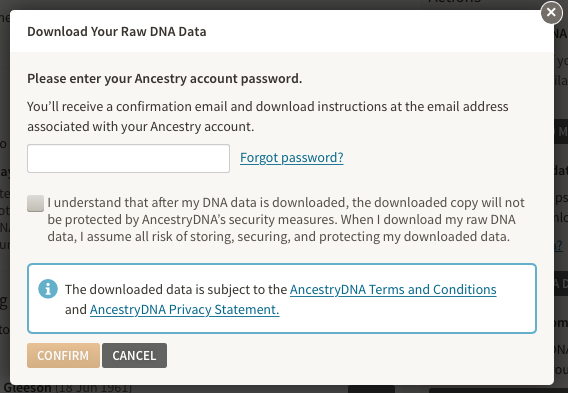
3. On the next page, in the box on the right, click on the Download Raw DNA Data button


4. Enter your password in the box indicated, and tick the check box below it ... then click on Confirm.


5. You will get a confirmation message asking you to check your email for a link to download your DNA.


6. Click on the green button in your email to confirm you want to download your raw DNA data.


7. This takes you to a new browser window where you will be asked to click on another green button (Download DNA Raw Data). Click on this (only once) and wait. This can take a while ...


... and be sure to note into which folder the DNA Raw Data file has been downloaded - you will need to access this folder in the next steps.


8. The next step is to upload the raw DNA data to FTDNA (FTDNA's instructions can be found here). Begin by visiting https://www.familytreedna.com/landing/atdna-landing.aspx.


9. New customers must enter their name and email address to get started. If you (or the person whose data you want to transfer) already have an FTDNA account, just click Already have a Family Tree DNA account? (Reminder: Each person needs to have their own kit number.) If you have an existing Y-DNA or mtDNA kit, be sure to sign in to it before launching the process.

Don't forget to click your gender and agree to the Terms of Service & Release Form.


10. Next, click Upload Raw Data to select and upload the raw data file from AncestryDNA from your computer. It is not necessary to unzip the file prior to uploading it.

The first round of results processing takes about an hour or so. An email notification will be sent to your registered email address after the raw data is processed. After the processing is complete, the free Family Finder experience includes:
  • your top matches
  • some Family Finder tools, such as the Chromosome Browser and the Family Finder Matrix. You can use the Chromosome Browser and Matrix with your matches to see the longest block and whether or not they’re an X match.
The free transfer has certain limitations compared to the full functionality you get for the $39 fee:
  • myOrigins is not included (genetic ethnic admixture estimates)
  • you cannot use the “in common with” feature
  • you cannot download any data
  • your results will not be seen by any of your matches

11. The price to unlock all of your matches and myOrigins results is $39. Once you’ve paid or unlocked your full results, it takes 3-5 business days for the full results to be completed.


Friday, 17 May 2013

Step 3.5 - other techniques to eliminate non-contenders

This will include:

  • mitochondrial DNA
  • Y-DNA

Step 3.4 - Using phasing to eliminate grandparental lines

This is a very complicated and time-intensive approach and requires testing multiple people to identify what parts of your DNA were inherited from which of your 4 grandparents. Testing might include at least 1 parent, 3 siblings, and several cousins.

The value of this approach is that it will potentially eliminate 3 of your 4 grandparental lines and in so doing reduce the number of possible contenders for Common Ancestor to a mere 25%. Taken in conjunction with the other techniques described in this blog, this can considerably narrow down the number of possible candidates for Common Ancestor.

The ISOGG wiki has a summary of phasing and how to do it. It also has some useful references at the end.

Monday, 13 May 2013

Step 3.3 - eliminating lines of unlikely ethnicity or nationality

Can you rule out certain ancestral lines on the basis of ethnicity or nationality?

This technique is not as foolproof as the ones previously discussed but it can certainly help you further narrow down your list of possible candidates for Common Ancestor. It works particularly well if you or your match have ancestors from a variety of different countries. For example, in my own family tree, all my ancestors are Irish (as far as I know). There is the possibility that if I went further back I might find some English, Welsh or Scottish ancestors too, but it is far less likely that I will discover Chinese or African ancestors within the last several hundred years.

Having said that, my ethnic admixture results from 23andMe reveal that I am 99.8% European and 0.1% Sub-Saharan African so this suggests that perhaps 1 of my 1000 or so ancestors (at the level of my 8x great grandparents, born about 1600) was African. So you can never be sure what awaits you in the unknown generations further back from where you have currently managed to extend your tree!

Nevertheless, I can be reasonably certain in suggesting to all my matches that any Common Ancestor that I share with them is likely to be Irish. As a result, they can focus their attention on any Irish lines in their own family tree. I'm not confident enough to say to them that they can eliminate any non-Irish lines from further consideration, but I can certainly say that the "balance of probabilities" sways more towards the Irish lines and more away from the non-Irish lines in their tree.

This could be given further credence by demonstrating that the segment of DNA on which we match is more likely to be Irish / European, rather than Asian or African (for example).

In her blog entitled X Marks the Spot, Roberta Estes uses an example from her own family to demonstrate the practical application of X-chromosome inheritance in combination with ethnicity and nationality analysis to narrow down the number of potential ancestral lines on which the Common Ancestor sits.

A Worked Example

Using the previous example of my aunt JH and MB, we were able to shortlist the potential ancestral lines to those marked with a red X (because JH & MB match each other on the X-chromosome). However, it is clear from MB's Bow Tie chart that her 3 specific ancestors 29, 30 & 31 are English, and therefore, while it is not possible to rule out these ancestral lines completely, it certainly points us away from these lines as potential candidates and draws our focus onto the other shortlisted ancestral lines (26, 27, and 21, 22, & 23).


Links, Reources, & Further Reading

Roberta Estes combines a variety of the techniques we are discussing to narrow down the list of potential candidates for her Common Ancestor in Revealing American Indian and Minority Heritage Using Y-line, Mitochondrial, Autosomal and X-Chromosomal Testing Data Combined with Pedigree Analysis. This article was published in JOGG (the Journal of Genetic Genealogy) Fall 2010, Vol. 6, Number 1, pp1-37.


Wednesday, 8 May 2013

Step 3.2 - a match on the X?


Do you match each other on the X-chromosome?

In order to answer this question it is best if you upload your raw DNA data to Gedmatch.com, as this is the best way currently available to assess if there is a match on the X-chromosome. Instructions on how to upload your results can be found here. 23andMe have an X-chromosome browser which can also be useful, and FTDNA is planning to introduce one at some point in 2013.

A match on the X chromosome helps to limit the possible ancestral lines down which the DNA you share with your match could have passed. The X chromosome can only be passed down certain ancestral lines.  Daughters receive one X-chromosome from each parent, sons receive an X only from their mother, but a Y from their father. For this reason, as you go back along your ancestral lines, anytime you hit a male ancestor, the X line cannot continue back through that male ancestor's father – it can only continue through his mother.

The diagram below shows the X chromosome inheritance pathways - orange arrows indicate the path of the X chromosome, blue arrows the path of the Y chromosome.  The X chromosome in the man at the bottom of the diagram is inherited only from his mother (orange arrow), who in turn could have got it from either her father or her mother, but her father could only have got it from his mother. Thus, as you trace the line of X-inheritance back, as soon as you hit a male, the line of X-inheritance can only continue back through his mother’s side. This effectively excludes all the ancestors on the paternal side of each male encountered as you go back through the family tree. Fabulous!


The X-inheritance pathways for men and women are illustrated in the Ancestor Fan Charts below, using me and my maternal aunt as examples. The only ancestors from whom the X could have been inherited are contained within the boundaries of the red lines.

There are several unique characteristics of X-chromosome inheritance including the following:

  •  If a male matches someone on his X-chromosome, this means that the common ancestor can only be on his maternal side. All the ancestors on his paternal side are immediately eliminated from consideration as possible candidates. (Caveat: the only possible exception would be if the match on the X-chromosome was a weak match - in other words, if only a very small portion of DNA on the X was shared between the two matching individuals. In such circumstances, the chances of the match being a “false positive” could be quite high. False positive matches are discussed further in the section on IBS vs IBD.)
  • The further back you go in your ancestral tree, the smaller the percentage of ancestors that could have passed you your X chromosome. This is illustrated in the tables below the charts.
  • Fathers pass on their X-chromosome unchanged to their daughters (i.e. it has not undergone recombination – click here for an explanation). Therefore, it is identical to the X-chromosome that he got from his own mother.  In other words, girls inherit one unchanged (albeit recombined) X-chromosome from their father’s mother.
  • On the other hand, a mother passes on an X-chromosome that has undergone recombination (and therefore represents a mixture of her two X-chromosomes, the one she got from her father and the one she got from her own mother). It follows therefore, that there is less recombination of the X on those ancestral lines that have more males, and more recombination on those lines that have more females. As a result, the amount of X-DNA that is passed down from any given ancestor is greater for those ancestors who sit on ancestral lines with more males, and lower for those ancestors who sit on ancestral lines with more females. (In the charts below, the “male heavy” ancestral lines are toward the left hand side of the enclosed red area, while the “female heavy” ancestral lines are towards the right hand side of the enclosed red area). The final chart below illustrates the average percentage of X-DNA inherited from each ancestor.


X Inheritance Pathways in Men


Below is the same sort of chart but illustrating the ahnentafel numbers of the ancestors concerned. Boys are in blue, girls are in pink. This is reproduced here with kind permission of Blaine Bettinger who uses these charts in his blog post here.


X Inheritance Pathways in Women


Below is the same kind of chart, but using ahnentafel numbers to illustrate the only ancestors who could have passed on an X. This is again used with kind permission of Blaine Bettinger.


Implications of X inheritance pathways in Men & Women

If you are man, a match on the X substantially reduces the number of ancestors who could have passed down the segments of DNA you share with your match. At the level of your great grandparents, only three out of the eight of them (37.5%) could have passed on any X-DNA to you. And if we go even further back, say to the level of your 5x great grandparents, only 21 out of the whole 128 of them (16.4%) could have passed on any X-DNA to you, thus ...

Generational level
Generation
Possible candidate ancestors - fraction
% ancestors
Relation to match
1
Me
1/1
100%

2
Parents
1/2
50%
Sibling
3
Grandparents
2/4
50%
1st cousin
4
great GP
3/8
37.5%
2nd cousin
5
2x g GP
5/16
31.25%
3rd cousin
6
3x g GP
8/32
25%
4th cousin
7
4x g GP
13/64
20.3%
5th cousin
8
5x g GP
21/128
16.4%
6th cousin

Similarly, if you are a woman, matches on the X also reduce the number of lineages down which the matching DNA could have been passed, although by not quite so much as that seen in males. An X-match thus narrows down the number of potential candidates for common ancestor between the person tested and their match ...

Generational level
Generation
Possible candidate ancestors - fraction
% ancestors
Relation to match
1
Me
1/1
100%

2
Parents
2/2
100%
Sibling
3
Grandparents
3/4
75%
1st cousin
4
G GP
5/8
62.5%
2nd cousin
5
2x g GP
8/16
50%
3rd cousin
6
3x g GP
13/32
40.6%
4th cousin
7
4x g GP
21/64
32.8%
5th cousin
8
5x g GP
34/128
26.5%
6th cousin

Furthermore, because the X-chromosome that a man inherited from his mother is passed on unchanged to his own daughter, any ancestral X-line that contains a lot of men will contain more X-DNA than a line that contains a lot of women. You can se this in the diagram below - look at the line toward the left that goes blue-pink-blue-pink and so on, and compare it to the one on the far right / bottom that is all pink. At the top gnerational level (5x great grandparents), the ancestor in the alternating blue & pink line passes on an average of 12.5% of the total X-DNA, whereas the ancestor in the all-pink line only passes on 1.6% of the total DNA (8 times less).
.


% of X-DNA contributed by different ancestors (in a male)

This chart illustrates the average percentage of X-DNA inherited from each ancestor – this is a population average and can vary considerably from person to person, but nevertheless can be useful in helping to focus attention on the most likely ancestral line on which the common ancestor sits. For example, if the suggested relationship between you and your match is 4th cousin (which implies a  common 3x great grandparent), and the percent of X-DNA you share is 20%, then the most likely of your ancestral lines to house the common ancestor is the most “male heavy” one on the left hand side of the coloured area above.

This chart is used with permission from Blaine Bettinger who used it in his blog here.

A worked example

According to Gedmatch, JH and MB also match each other on the X chromosome, thus:


There are only certain ancestral lines down which the X-chromosome can be passed (marked with a red X in the Bow Tie charts below). Therefore, this match on the X effectively eliminates certain ancestral lines from consideration on both my tree and my matches tree - ancestors without a red X are “highly unlikely” to be candidates for the common ancestor and the ancestral lines on which they lie need not be considered further.


Links, Reources, & Further Reading

Roberta Estes combines a variety of the techniques we are discussing to narrow down the list of potential candidates for her Common Ancestor in Revealing American Indian and Minority Heritage Using Y-line, Mitochondrial, Autosomal and X-Chromosomal Testing Data Combined with Pedigree Analysis. This article was published in JOGG (the Journal of Genetic Genealogy) Fall 2010, Vol. 6, Number 1, pp1-37.

Blaine Bettinger discuses the dynamics of X-chromosome inheritance and its application to genealogy in two blogs from December 2008 and January 2009.

Jim Owston blogs about his experience of Phasing the X chromosome

In her blog entitled X Marks the Spot, Roberta Estes writes about the practical application of X-chromosome inheritance in her own family.